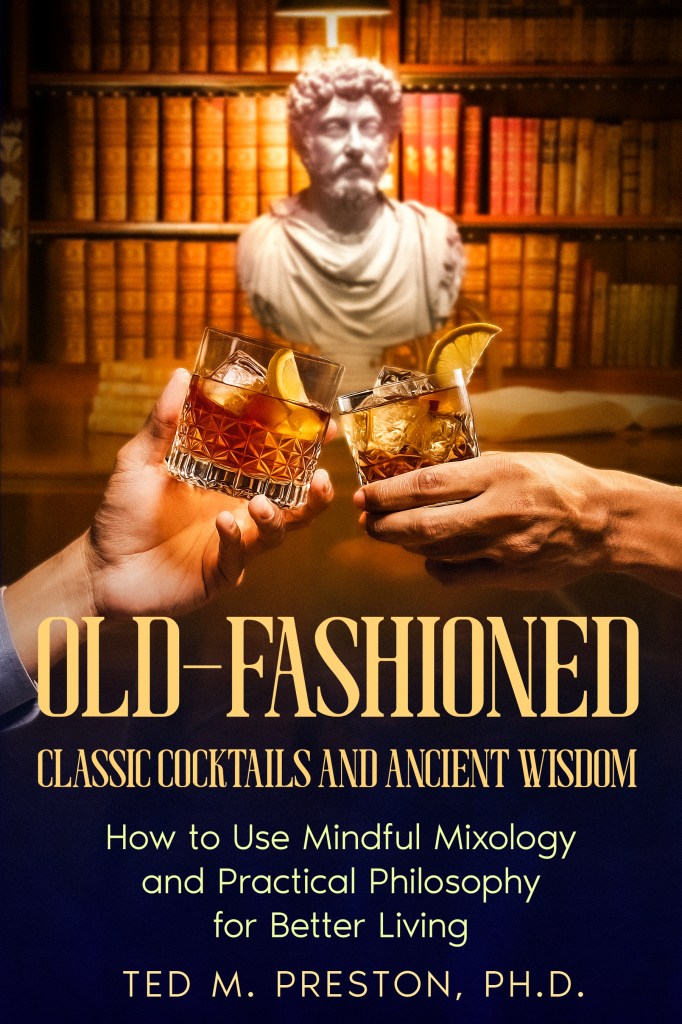
Classic cocktails meet practical philosophy
Old-fashioned is a year-long exploration of practical philosophy, organized around 52 classic cocktails and 52 opportunities to put ancient wisdom into practice. Each week pairs a drink with a passage from an ancient philosopher, commentary on its relevance to modern life, and exercises designed to turn philosophical ideas into habits.
About the Book
Old-fashioned: Classic Cocktails and Ancient Wisdom brings together two traditions built around attention, ritual, and the art of living well. Across 52 weekly meditations, classic cocktails provide the occasion for exploring ideas from Stoicism and other ancient philosophical traditions. Each chapter combines a cocktail, an ancient passage, commentary, and practical exercises intended to help readers apply philosophy to everyday life.
The result is not simply a cocktail book or a book about ancient philosophy, but a practical guide to using both as opportunities for reflection. No previous knowledge of philosophy—or expertise behind the bar—is required.
What You’ll Find Inside
- A classic cocktail — one for each week of the year.
- An ancient passage — a short selection from Stoic and other ancient philosophical sources — with a bonus more contemporary source tossed in).
- Commentary — an exploration of what the passage can tell us about living well today.
- Practical exercises — concrete ways to put the week’s philosophical idea into practice.
A Sample Week
Week 13: Manhattan
Recipe
Ingredients: 2 oz rye or bourbon, 1 oz sweet vermouth, 2 dashes Angostura bitters.
Instructions: Stir whiskey, vermouth, and bitters with ice. Strain into a chilled glass. Garnish with a cherry.
Quotation
“It is circumstances (difficulties) which show what men are. Therefore when a difficulty falls upon you, remember that God, like a trainer of wrestlers, has matched you with a rough young man. For what purpose? you may say. Why that you may become an Olympic conqueror; but it is not accomplished without sweat. In my opinion no man has had a more profitable difficulty than you have had, if you choose to make use of it as an athlete would deal with a young antagonist. (Epictetus, Discourses, 1.24)
Commentary:
Life can be challenging! So many “obstacles” pop up for us in life, and some of us seemingly have more than our fair share compared to others. Some people are born into poverty, abusive households, or otherwise have a challenging childhood. Some people have (or acquire) mental or physical disabilities. Some people are born with health challenges or acquire them later in life. Eventually, as we age, we all must grapple with declining health. Some people struggle with addiction, some grapple with unemployment, some are members of persecuted minority groups, some are bullied, etc. The list of challenges people can face throughout their lives is seemingly inexhaustible, and it is very easy to get frustrated, upset, depressed, or angry about our difficulties—and understandably so!
In this selection from Epictetus, the former slave who had a disability in his leg inflicted upon him by his former master, offers a way to reframe difficulties. Remember that a key exercise for Stoics, in general, is to recognize the things that are up to us versus the things that are not. That we face difficulties is not up to us. How we face difficulties is up to us.
No matter how many precautions someone takes, no matter how many risk-reduction strategies someone employs, it is impossible to guarantee a life without difficulties—and Epictetus would suggest that we shouldn’t want to even if we could.
Epictetus offers a grappling analogy, comparing difficulties in life to being paired with a “rough young man.” The analogy is simple, even if you don’t have any personal experience with something like wrestling, jiu jitsu, boxing, or other martial arts. I do have relevant experience with those sorts of things, so I can testify from personal experience that I usually learn the most when my training partner (“opponent”) is a challenge for me. When I am “rolling” with a grappling partner, and that person is smaller, lighter, and less experienced than me, it is easy for me to be “dominant” and it is tempting to just go for easy submissions. However, when I am partnered with something bigger and stronger (which is almost always the case, given my size!), I literally can’t rely on my own strength and must rely on superior technique and creativity instead. In those cases, I learn how to overcome strength with patience and leverage. Or, when someone is more skilled than I am (which is also often the case, given my relative inexperience in grappling), I often learn what not to do, as I am submitted again and again.
In theory, every time I face a challenging opponent, I get a good workout, I learn something, I get better (even if only marginally), and I am better prepared for the next time I grapple. The same principle applies to other martial arts that involve sparring, as well as any competitive sport or hobby (e.g., basketball, tennis, golf, online gaming, chess, etc.), but also to non-physical “sparring” as well, such as occurs in formal debates, as just one example.
What might be less obvious, but what is essential to the point Epictetus is trying to make, is that events throughout our life function as “sparring partners” for us. Our opponents can wear many faces. Unemployment. Cancer. Abusive relationships. Addiction. Disability. Immigration status. Imposter syndrome. ADHD. The examples are endless, and Epictetus’ advice is clear and brutally practical: focus on the learning and growth opportunity made possible by a challenging “partner.”
People who struggle with health issues have an opportunity to develop compassion for others with health issues, patience in dealing with their own, knowledge of health management, courage in the face of scary diagnoses, and gratitude for moments of health and life itself, among other things.
People who struggle with being bullied have an opportunity to develop compassion for others who are targeted, kindness for others, self-compassion, resilience, and a reliance upon true friends and allies, among other things.
“Let me not pray to be sheltered from dangers but to be fearless in facing them.
Let me not beg for the stilling of my pain but for the heart to conquer it.”[1]
This portion of the poem “The Grasp of Your Hand,” by Rabindranath Tagore, not only recognizes the value of struggles, but is so bold as to pray not to spared from them, asking instead for the courage face dangers and pain.
One doesn’t become stronger by lifting overly light weights, or a better grappler by dominating easy opponents. Sometimes, we have the opportunity to choose a stronger opponent for the sake of the growth opportunity, such as when we try something new (even if, and especially if, it is not something we are already “good at”), or by enrolling in an “honors” section of a course instead of the standard version, etc. Doing so is like making the conscious decision to join a gym and start working out. See it through, and you’ll become “stronger.”
Sometimes, our challenge is not chosen, and, if given a choice, we would undoubtedly decline the opportunity. Even then, Epictetus encourages us to make the best of it.
This is certainly easier said than done. Returning to the previous example of sparring, sometimes a challenge can be too challenging, and in those cases learning opportunities are limited. There have been times when I have sparred with someone much bigger and stronger than I, outweighing me by more than a hundred pounds, and more skilled and experienced than I am. Being thoroughly outmatched, the best I could do was “survive.” I don’t know that I learned much “jiu-jitsu” while I was getting smashed and rag-dolled, but perhaps I learned that I am tougher than I might have thought; that I can endure difficult and literally painful situations? Maybe, sometimes, the only learning we can experience is some sort of lesson in character.
It is pretty “enlightened” to be able to find gratitude for all the challenges in your life. Some challenges might legitimately seem too challenging. But, difficult though it is to find gratitude, it is arguably better than the alternative. Lamenting our circumstances is natural but does nothing to improve them. Seeing a difficulty in life as a challenge to be overcome, and a way to become “stronger,” is much more hopeful and motivating, and, I would propose, makes us more likely to be able to ultimately overcome the challenge—even if overcoming the challenge, in the end, just amounts to facing it with courage.
[1] https://www.harvardsquarelibrary.org/poetry-prayers-visual-arts/rabindranath-tagore-prayers/
Exercises:
- Do you have any experience with athletic activities such as competitive sports or performance, or intellectual competitions such as debate, or even just “working out?” If so, in your experience, what sorts of challenges were “better” for you in terms of developing skill? Easy ones, or more difficult ones?
- What are some challenges in your life that you have faced, or are you currently facing? Try to think of a few and (roughly) rank them in terms of the difficulty of the challenge they offer you. Are they easy? Impossible? Difficult but achievable? Moderate?
- Pick one of those challenges as an example—probably one that is at least “moderate” in your ranking. Just as an experiment, imagine this challenge to be a “training partner,” even if the challenge is not a person. When you imagine them as a “training partner,” does it produce any changes in what you think about that challenge, or how you feel about it? Does imagining the challenge as a “workout” help you to feel more positive about the existence of that challenge?
- Using that same example that you picked in #3, consider what sorts of growth or personal improvement you might expect to gain from facing it. In what specific ways might it make you “stronger?” Can you become more courageous, or more confident, or more patient, or more generous, or more compassionate, etc.?
- Repeat these exercises with other examples, as appropriate.
Old-fashioned: Classic Cocktails and Ancient Wisdom
Old-fashioned will be published on November 20, 2026, in paperback and Kindle editions through Amazon.
 Ted M. Preston